
Article by Miriam Hastings
I have always had a vivid imagination and when I was a child I lived in the fantasy worlds I created. I was ill a great deal from babyhood so I spent a lot of time alone in bed and all my friends were characters I met in books or in the stories I invented myself. So I never made a conscious decision to be a writer – I have been making up stories ever since I can remember and writing them down from the moment I learned to write.
I think I write fiction as an adult to meet the same needs I had then. I was a lonely and often an unhappy child so this was partly a need to escape from reality but also I think both then and now it meets a need to address the problems life poses by approaching them from a more creative angle. Writing is a way of taking control of reality because you can shape it and reshape it through words, expressing your own experience and vision of the world and, through doing that, you can transform reality into something greater.
Writing a novel can be very daunting: it seems such a huge, long-term commitment and it is lonely work. You can’t really workshop a novel so it’s difficult to get feedback while you’re writing it, and although you can publish extracts in magazines, this is never satisfactory as it involves taking fragments of the whole work out of context. Thus any feedback you might receive as you go along is often based on misunderstanding.
This means a novelist needs perseverance and patience in the face of isolation as a writer. It helps to take one step at a time – I find novel writing is like doing a large, complicated jigsaw puzzle. I know what I’m aiming for but I don’t tackle the whole picture at once, just a small area at a time as I might concentrate on the sky when doing a jigsaw; I recognize and build up connections gradually. Once I am about halfway through, it becomes much easier, sections begin to fit together and I see the whole work taking shape. I find the important thing is to keep writing; I don’t let myself get stuck over Chapter 2 if I could easily write Chapter 6, I know Chapter 2 will become clearer later. A novel is a long piece of work – if you don’t keep writing, it will never come into existence at all so you do need to be disciplined about it.
In the years when I was studying and working it was often hard to find the time to write regularly. Now I have more time, I would ideally like to write for at least an hour or two every day but I am disabled with a progressive degenerative illness that affects my spine, so these days my major problem is living in severe chronic pain and also suffering from stiffness and weakness in my hands and wrists which make the physical act of writing difficult. I use voice recognition on my computer to overcome these problems, and I have a wonderful dictaphone which I can carry around with me and use for making notes and capturing ideas. I can download my notes to the computer from my dictaphone, although this involves a lot of correction and editing so it isn’t always useful. My voice recognition software (Dragon Naturally Speaking) is very helpful because I’ve been using it for over 20 years so it has become trained to my voice and my vocabulary. In the beginning I found it quite a challenge. Sometimes it would write things totally different to anything I had dictated! This could be quite surreal.
When writing a novel, I find it helps to keep some distance between myself and my central characters so that they are presented vividly but they don’t take over the story: using the third person narrative voice can be helpful in this respect; also, the device of having more than one narrator. In my latest novel, The Dowager’s Dream, there are two central narrators who each see the main events of the story from a different perspective. This novel feels very personal to me – possibly the most personal of all my novels – although it’s set in the north of Scotland during the early years of the 19th century, at the time of the Highland Clearances. The story was partly inspired by the lives of my great, great-grandmothers, Margaret MacKenzie and Christine Patterson, also by an extraordinary account written in 1809 by the Minister’s daughter of Reay, describing a mermaid she saw in Sandside Bay, Caithness – but the mermaid in The Dowager’s Dream is not pretty, being a dark symbol of both sexual and cultural repression. For several years I was researching the Highland clearances and themes of dispossession and ethnic cleansing are central to the novel.
However, although it seems that I’m creating an entirely imaginary world, I find that life has a habit of creeping up on me unawares. I often think that writing fiction is very similar to the process of dreaming: often when we analyse our dreams, they echo aspects of our own lives and we find facets of ourselves shown us from a new perspective. Like my dreams, I find that my fiction, however remote it may seem from my own experiences in terms of historical period or life events, can always show me something about myself from the patterns that have emerged from my unconscious mind. These are rarely obvious and it is unlikely that another person would notice them, but they gradually appear like a developing photograph, or like clouds taking recognizable shapes; faces, mountains, islands surrounded by water, mirroring the terrestrial world in a strangely transformed manner. When I look at the fiction I have written in the past, I find certain patterns being played out over and over again; patterns of relationships, patterns of survival, which frequently have resonances in my own life. An obvious example is a relationship between two girls or women that reoccurs again and again in my novels and often mirrors my complex and sometimes difficult relationships with my sisters. In The Dowager’s Dream, the relationship between the two narrators, Mary and Kirsty, is especially challenging since Kirsty is Mary’s servant as well as her friend.
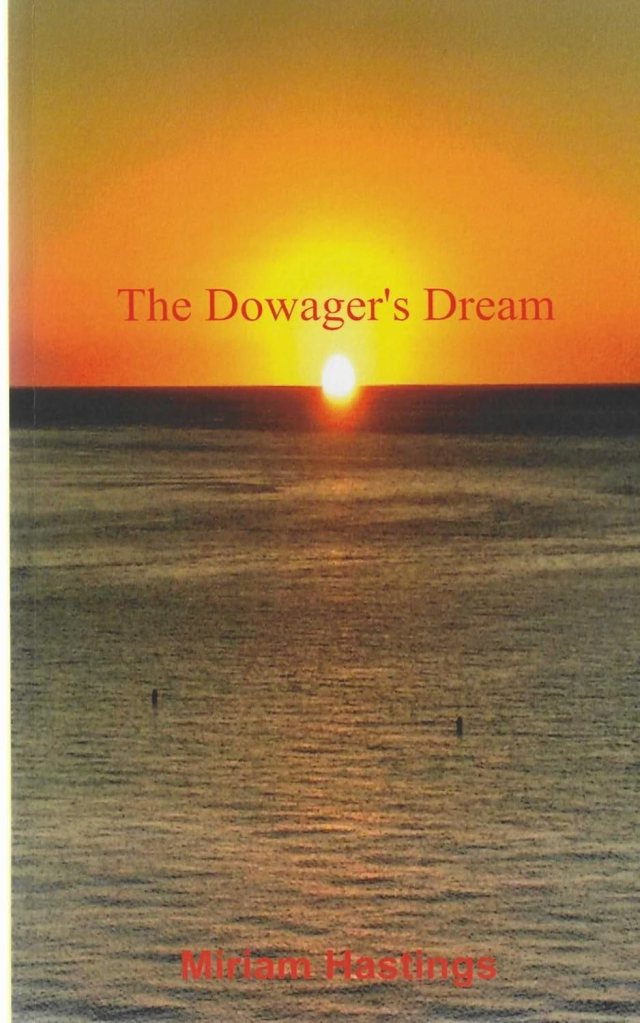
Here is an extract from The Dowager’s Dream, pp316-318:
‘Kirsty stared at me, “You . . . you knew too?” she turned as white as her own kerchief, “You knew as well as he did? Why did you no tell me? Why did you no do something?”
My cheeks burned. I could understand why she felt we had betrayed her, and all the people besides. If I had said as much and begged her pardon there and then, maybe our lives would not have unravelled as they did.
“There was nothing she could do, lass,” said Father, and rather to my surprise his voice was gentle.
“You could have told me,” Kirsty said, still addressing me, “you could have told me; I would have done something.”
“There was nothing you could do, Kirsty,” I protested, “your Uncle George and Aunt Lucy could do nothing, you know that.”
“I would have done something,” she repeated, “I would have had the will, even if you did nae.”
“That isn’t fair,” I cried, “of course I had the will, but what could I do? What could you have done?”
“I would have warned my friends and neighbours, we might have been heard if we’d all spoken out together, before the notices to flit had been made up. We could have fought for our land. I would fight, indeed I would!”
“You should be keeping quiet and doing your duty to those above you, nae making trouble like those murdering savages did in France!” said Father, sounding angry now.
“My da and mam are to be homeless, they are to be robbed of their land – land my family have tended and worked on for time out of mind – and I am to say nowt! Do you think this is a right, Miss Mary, do you think there is any justice in this? Would you say nowt?”
Patient Griselda, distressed by Kirsty’s excited voice, had come to her side and now she got up on her backlegs to pat Kirsty’s hand as was her wont. Kirsty scooped her up and pushed her into my arms, “I am no Patient Griselda,” she shouted, “nor will I ever be. I am no hypocrite – and I am no Judas that can be bought with bribes and promises to betray my Christian duty!”
Father gasped and floundered for a moment, too shocked by her words to speak, then he found his voice. He was red in the face, though whether from shame or fury I cannot say for sure, but he did not look her in the eye even as he raged at her, “Listen to yourself, you wretched girl! You dare to talk of Christian duty when you openly flout those God has put in authority over you? You dare to accuse me – your master and your Minister of religion – as if you had either the wisdom or the understanding to know what is right and what is just!”
“Well, Minister, you will be glad to know you are no longer my master or my priest. I will no stay here to serve you and I’ll never enter your Kirk again, I scorn you and your fine words I’m going to my mam and da, I will help them if you will nae!”
“Of course we want to help them,” I began, but she had already turned from us and left the room. I could hear her climbing the stairs.
I moved to go after her but Father shouted, “Let her go!”
Poor Griselda trembled in my arms and I soothed her as best I could with tears running down my face. It was not justice – Kirsty was right, there was no justice in it.
“Let her go,” Father repeated dully, “let her go for now, she’ll be back soon enough.”
He retired to his study – to his opium, no doubt, taking a new flask of whisky with him. I dreaded the result but had no time to fret for I knew I must stop Kirsty before it was too late. I ran upstairs to her attic chamber and found her packing her box. She even threw in her Bible and seeing it, I trembled; if she was taking that, I knew she was serious.
“Please don’t leave me,” I said, my heart hammering at the very thought of being without her.
“You should have told me,” her voice was cold and hard, “how could you do this? How could you no tell me?”
“Kirsty,” I protested, “it would only have upset you, you might have done something stupid, you might have got hurt.”
“Hurt!” she shouted, throwing her bundle over her shoulders and lifting her box, she headed passed me down the stairs, with me following, pleading.
I grabbed her box from her, “I will hide this,” I cried, “I won’t let you take it!” Struggling a little with the weight, I carried it to my own chamber and locked it in my closet.
But Kirsty passed by my door with her bundle in her hands, “It is no good, Miss Mary, I will send Peter for my box,” she said, as coldly as if she cared for me not at all.
“Please,” I begged, “it was not I who preached today, it’s not fair to blame me so.”
Kirsty stared at me as if she thought me foolish beyond belief, there was something akin to pity in her eyes, as well as contempt’
Follow Miriam Hastings:
Website: https://miriamhastings.com/
Facebook page: https://www.facebook.com/MiriamHastings.author/
Instagram: https://www.instagram.com/miriam.hastings3/





 Chasing Driftwood Books