Author Lessons Part 2: Indie Publishing, Burnout, Author Extras, Control, and Writing Project Grief

by K.M. Allan

If you’ve stumbled onto this post without reading part one, Author Lessons: Writing Community, Social Media, Newsletters, and Support, you can find it here. Part two covers the rest of the lessons I’ve learned in the last nine years. They are based on my own experiences and may be different from yours. I’m just sharing what I know in case it’s of help to any other writers traveling the same path.

image belongs to K.M. Allan

Author Lessons

Indie Publishing

Like most writers, I took my shot at traditional publication. I queried for several years, got rejections, 2 full requests, and even signed a small press contract.

In the end, all books published under my name so far have been indie published by me. There are many ways to do this, and a quick Google search will no doubt give you step-by-step blogs by more seasoned professionals.

As this post is about my author lessons, this is what my experiences in indie publishing have taught me.

Four years ago, I went with IngramSpark. Nowadays, good practice is using Ingram or Draft2Digital to go wide (all retailers but Amazon), while also publishing directly with Amazon.

I’ve recently heard rumblings you can now also go direct with Apple, and Barnes and Noble, etc, but I suspect that’s a US thing.

When I was researching publishers to go with, I did look at Draft2Digital, but they don’t have a printing facility where I live, and Ingram does. This means it only takes mere days to get physical copies of my books. I also found that the print quality of paperbacks is better with Ingram than Amazon, which is another reason I chose them.

Ingram used to charge to publish books. Now they don’t, but if you need to make changes, such as fixing typos or updating your book content, it will cost you. I have heard Amazon allows you to update your files without incurring a cost, but again, I currently have no personal experience with the inner workings of publishing through Amazon.

Another tick in the going with one publisher box was not wanting to check separate places for sales. Ingram has one dashboard, and it’s easy to run reports from.

Can you now guess where I sell most of my books? Yep, it’s Amazon. A place where I’d get higher royalties if I was going directly with them (and that’s on me). I also have one reader who has so far bought every ebook I’ve released on Kobo, and occasionally I’ll get an Apple Books ebook sale.

As an indie publisher, you’ll set the recommended retail price, but Amazon and others don’t have to stick to it, and they usually won’t.

Sometimes you’ll see your books on sale and be able to tell people who will hopefully take advantage. Other times, you’ll see it so ridiculously priced that even you wouldn’t buy it. No one else does either, and months will go by with no sales.

As for advertising your books and marketing, this is the hardest part of publishing and is a constant uphill battle. I’ve heard mixed things about doing paid ads, particularly Facebook ads, and it’s not something I’ve waded into (yet).

My first book release was at the start of the pandemic when everyone was reading and I reaped the benefits. I’ve also released two books at the end of the pandemic when no one was reading or spending money and suffered the consequences—just like every other author.

I’m in two minds about Amazon. They seem to punish writers who aren’t using them. More than one release day has been marred by people not being able to order my books because Amazon listed them as “Unavailable”—all because they’re coming from Ingram and not them.

I can tell you from firsthand experience that if readers can’t buy your book when they want to, or they see a message that it’s not in stock and there is no date for when it will be in stock, you’ve lost a sale.

I’ve also read recent horror stories on Threads of Amazon suspending writer accounts and canceling pre-orders, which are sales most indie authors won’t get back.

I’m also sure I’ve had some sales they have never been reported to Ingram. That’s not to say Ingram is fantastic either. If you contact either company about lost sales, incorrect listings, missing covers, or outrageous prices well above the RRP, they blame the other companies and say everything is out of their control, leaving you with very little control.

I’d love to sell my books directly from my website, but the cost of postage makes it impossible, even within my own country.

Lesson learned: no publishing place is perfect, and all will frustrate you. Weigh the pros and cons for yourself and go with the company that’ll work best for you. Maybe one day there will be better solutions, but for now, we can only work with what we’ve got access to.

Burnout

Posting on social media consistently, writing manuscript after manuscript, being in the query trenches or on submission, and just being in an endless loop of waiting to hear what others thought of your MS/pitch/query/submission pages, and checking if your last post got enough views/likes/comments or was swallowed in the social media void yet again, takes its toll.

Doing all of that, being in that constant state of waiting, plus the internal drive to get better in an industry where you’re only as good as the last piece of content posted or book published quickly leads to disillusionment, burnout, and self-doubt.

Lesson learned: remember that you got into this because you love to write, that you keep trying because you love to write and you want others to read what you wrote, to connect with it like you do. If you find everything else is robbing you of that love of writing, take a break. Reassess things and always go back to writing.

Author Extras

The trend at the moment for author extras seems to be character artwork (made by fellow artists, not AI) and if that is something you can afford and want to include, go for it.

I haven’t commissioned such work, so I can’t speak on it, but I can say the author extras I’ve spent money on have been bookmarks, enamel pins, a tarot card based on one featured in my series, tote bags, mugs, and chocolate bar wrappers (this post contains some pics if you’re curious). These were done as giveaways to beta readers, book launch comps, and book launch swag.

I’ve also invested in business cards, which I took to my first writing conference in 2017. They were left on a table, along with everyone else’s cards. I still have a box of them sitting in my desk drawer. There haven’t been too many other places to hand such things out as COVID killed off a lot of in-person conferences.

If you go to such events often, it is a good idea to have either a business card, bookmarks, or other swag you can hand out. I suggest using a QR code on them so you can keep the info updated. My business cards have an old domain on them (which still works) but it makes me hesitant to hand them out as I know it’s not the latest and easiest info.

Lesson learned: if you can afford to get some author swag, do it. If you can’t, don’t. As much as social media would like you to believe that a release that doesn’t include sprayed edges, limited edition hardcover copies, or a candle that can be included in a giveaway box means your book will fail is all wrong. Make the best book you can. That’s the priority.

If you want extras and can swing them, go ahead. They may garner attention, but if the book is bad, a sticker of the cover art will not improve its standing amongst readers.

Control

One big lesson I’ve learned is that you have control over what you initially write. And that’s it.

The book those first few drafts will become is something you have less control over as feedback from editors and beta readers will change the book’s shape. Then, when it’s released, you’ll never have control over how it’s received, how and when it’ll be reviewed, how much it’ll sell, if your promo posts work, or if it’ll be picked by readers, let alone a bookstagrammer that will make it go viral.

Lesson learned: all you can control is the words, the next book you’ll work on, and your reaction to everything. Focus on those things, and learn to let go of everything else.

Writing Project Grief

One surprising thing I’ve gone through when finishing a writing project is a grieving process. Wrapping up a book series that was a part of my daily thoughts and life for a good chunk of time (twenty-two years) hit harder than I expected.

Often, a work in progress that spans years becomes part of your life as you write it while trying to figure out who you are. When you finish that project, that part of you is now also gone. So are the hopes you once felt for this idea that bloomed into something so big.

Some books achieve what you want—getting written. Others almost hit that ultimate writing dream. You may have landed goals you never dreamed of, such as signing with an agent, a publisher requesting a full, getting all the way to an acquisitions meeting, and signing a contract. Or you could have watched all those things happen to others as the years and luck passed you by.

Sometimes, even when books achieve more than you dreamed, they still don’t hit the specific expectation you wanted, so you grieve that too.

That writing project isn’t the breakthrough you’d wished for, but now a backlist book you hope will eventually be discovered by others.

Lesson learned: your next book may not live up to your wildest dreams, or it may surpass them. Write the books of your heart, adjust your expectations to reality, but always keep a little sparkle of big-wish hope. It’ll keep you going.

And those are my author lessons. I hope you’ve gotten something from these two posts, and if you have questions about what’s been written, or want to ask more, let me know in the comments.

— K.M. Allan

Find me on InstagramFacebookGoodreads, and Threads. You can also sign up for my Newsletter to get my blog posts delivered directly to your inbox!
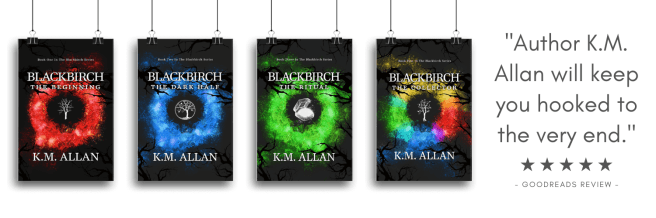
image belongs to K.M Allan

Author Lessons: Writing Community, Social Media, Newsletters, and Support

image belongs to K.M Allan

Author Lessons Part One by K.M Allan

While I’ve been writing for over twenty years, as of 2024, it’s been nine years since I launched my author accounts.

Later this month also marks one year since I completed my debut series, Blackbirch. When I started writing an upcoming blog post to mark that occasion, my habit of rambling off-topic led to lessons learned in the authoring game—so here they are!

Author Lessons

Every writer’s journey is different, but we’re all striving for the same goal, and that’s to put our art into the world, hope it finds an audience, and go with the lowest of lows and the highest of highs.

Because of those shared goals, I’m going to share parts of my journey regarding the lessons I’ve learned as an author.

When I started taking writing seriously, there was a lot I didn’t know. There’s still a lot I don’t, but there are some things I do thanks to years of consistently running social media accounts, blogging, and releasing books.

I wish I could say I was a runaway success at any of these, but I’m just like most people—putting myself out there and hoping it works.

The Writing Community

The first lesson I’d advise, and what I did, was join the writing community.

Even though writing is a solitary effort, I would not be where I am today without the friendships made and the support I’ve received.

My intro to the writing community was kick-started by starting social media accounts, this blog, and interacting with fellow writers. I’ve had friendships develop from beta reading and swapping manuscripts with writers in other countries, some of whom I count as good friends today. I would not have made those connections without putting my little introverted self out there, and you can do the same.

What I’ve also found in the writing community are fellow writers who will encourage each other, write with each other regularly for years, meet up in real life, go on writing retreats together, beta read for each other, and support each other’s books. As a part of the community, I’ve also read some of the best books, and found new favorite authors with backlists I’ve devoured.

While a reason to join the writing community is to get your name and work out there, it’s also about making connections. Find friends, not just potential customers/readers. They will help you more than paid assessment services, will lift you up when you get bad reviews, rejections, and disappointments, and encourage you when you feel like giving up.

They’ll support your books and you, and if they’re writing too, they’ll understand. They know what it’s like to put your heart and soul on the page and not have it come out how you want it to.

Lesson learned: the writing community gets the ups and downs because they are in the trenches too. It might take you a while to find others you mesh with, and writers will come and go from groups just as friends do in your life, but it’s all worthwhile.

Social Media

Years ago, I used to worry about taking time off from posting on social media, because if you took time off, you’d come back to no engagement and fewer followers.

Now, there’s so little engagement across all platforms that most people don’t even notice when you’ve taken a break.

You can do absolutely everything in your power on social media and follow every tip posted by those who have been successful, and in the majority of cases, nothing changes.

Don’t burn yourself out over it. Do what you’re happy to do. If you like making and posting graphics, do that. If reels are the only thing you can create at the end of a long day, post reels. If you can swing posting Monday to Friday, but take weekends off, take the weekend off!

I spent years posting 6 days a week, trying to find the exact right time, and the right posts, and you know what happened? My social media numbers grew quickly and then stopped.

On Instagram, I quickly gained over 2,300 followers—and that’s it. For the last 9 years, my follower count has stayed the same. Doesn’t seem to matter what I post, who I follow, or what I do, I can’t grow the numbers. Occasionally I’ll go up by 5, but that number then dwindles back down.

My Facebook author page has limped up to 600-odd followers. Twitter for a brief time was the best and got to around 3,000, but then Twitter went to crap, the majority of the writing community left, and I barely check it anymore.

My blog/website has had the best growth and follower count. Almost 5,000 of you amazing readers follow my posts, but like everything in 2024, the algorithm has strangled reach and engagement is now down here too.

Do you know how I get any new followers now? From real life. The few times a year I go to a book event, everyone just looks each other up on Instagram and then we follow each other to keep in touch. I’ve gained more followers doing that at two recent book launches than I have for the last two years.

Lesson learned: You can’t control social media, you can do everything “right” and still not get anywhere, which you’ll of course blame yourself for even though it’s out of your control. So…

  • Post what you enjoy and what you’re comfortable with.
  • Post when it suits your lifestyle, not rumored rules that no one can verify.
  • Accept that you can’t control it all.
  • Engage when you can.
  • Don’t expect others to reciprocate with likes, comments, and shares. Most don’t, and most of the time it’s because they honestly don’t see your posts, even if they’ve been following you for years.
  • You’ll find people who will interact with you regularly—do the same for them.
  • If you’ve reached a point where checking social media gives you anxiety, take a break. The world won’t end.

It will feel pointless most days, and as much as I’ve moaned about social media, I wouldn’t have sold the books I have without it. The best way is to run your social media accounts, don’t let them run you.

Newsletters

From July 2019 until October 2020, I ran a newsletter. It was a free version with Mailchimp, so it didn’t cost me anything but time to put it together and send it out, and I enjoyed doing it when I first started.

Like my social media accounts, the newsletter got stuck at 210 subscribers, and then most subscribers stopped opening the emails.

In the end, putting together the newsletter content was taking time away from writing and editing, so I closed it down and now publish the content on my blog as my roundups. My current version of a newsletter is now encouraging readers to subscribe via email to my blogs (which you can do here).

Having a newsletter gives you direct contact with readers who are interested in your work, and isn’t reliant on an algorithm showing your content to others, so there will always be an incentive to start one.

If, like I did, you find the effort is costing you in other areas, no rule says once you start a newsletter you must keep it going for the rest of your life.

Lesson learned: always reevaluate what works for you, and don’t push yourself to do something you hate because social media (or blog posts like this) say you should have a newsletter. If a newsletter works for you, start one. If it doesn’t, don’t.

Support

You’ll never get more support than with the first of things.

First time in the query trenches. First full MS request. First rejection. First published book. You should celebrate all these things, and you’ll find most people will celebrate with you, and support your posts with shares, comments, wishes of luck, cover reveals, and release day announcements.

First books will be bought by friends, family, and followers who’ve been watching your writing journey progress and want to see what your work is like.

The longer you’re around, the more work you release, the different ways that support fluctuates. In a perfect world, every release of anything new will build and become more. In reality (for the majority) support drops off. Not because you’re getting worse, but because that’s life.

Lesson learned: support who you want, and don’t expect the same level of support back, or support to last forever. Always (and I am) be grateful for any support given, especially from those who show up year after year, release after release. They’re worth more than subscriber numbers or sale figures.

As this turned into a bigger-than-expected post, I’ve split it up for easier reading.

Part two can be found here and covers indie publishing with IngramSpark, thoughts on Amazon, burnout and self-doubtgrieving the end of a project, author extras, and what you can and can’t control.

In the meantime, if you have any questions about the topics in this blog post, drop them in the comments.

— K.M. Allan

Find me on InstagramFacebookGoodreads, and Threads. You can also sign up for my Newsletter to get my blog posts delivered directly to your inbox!

image belongs to K.M Allan

A Brief Discussion of Publishing Options

What are the choices available to writers today?

There was once a time when the only way to get your book published and in front of readers, was to get an agent followed by a publishing contract. This option still exists, of course, and is now usually referred to as ‘traditional publishing’. It’s traditional in the sense that the same rules have applied for a long, long time. These days the traditional model is not the only option for aspiring authors and in this blog post we will briefly examine the other options available.

Image by Mirko Stödter from Pixabay

But first – a very brief history of the rise of self-publishing!

  • 1993 the worldwide web becomes accessible to all, opening the doors to self-publishing
  • 1997 Lightning Source, POD company is founded, opening the market up to small presses and indie pubs and inspiring companies such as Ingram Spark and Lulu.
  • In 1999, blog hosting takes off. Writers use blogs to share their work.
  • In 2000 Stephen King was the first major author to self-publish a book (The Plant) online in electric instalments.
  • In 2007 Amazon launches Kindle Direct Publishing, allowing authors to self-publish their books to be read on the Kindle e-reader.
  • 2008/09 crowdfunding platforms like IndieGoGo and Kickstarter make it easier for artists and writers to raise money for projects.
  • 2011 increasing numbers of people own e-readers and companies like BookBaby and Smashwords allow writers to publish and distribute ebooks worldwide.

And since then, things have continued to change and evolve! In fact, it’s pretty hard to keep up and anyone thinking of discussing the subject or offering a workshop or course, would certainly need to do their research again to ensure their information is up to date.

We’ve mentioned self-publishing so let’s examine that first.

Self-publishing

Many people assume self-publishing simply means uploading a manuscript and book cover to Amazon and pressing ‘publish’. In reality, it’s far more complicated and complex than that, and even self-publishing has more than one option available to you.

  • Go it alone with Amazon Select
  • Go with Amazon and other distributors. (Draft 2 Digital is a major one)
  • Go with a  publishing platform such as IngramSpark, BookBaby or Smashwords
  • Pay for a publishing company to edit, format and market your book
  • join up with other indie authors and form a publishing collective, such as Chasing Driftwood Books

All of these options have benefits and drawbacks to them and if self-publishing is the route for you, it’s a good idea to research the various options available before you start. Your final choice might be what suits you and your book or it might be decided by finances as the options have different price tags. The most important thing to consider is the professionalism of your book. In order to compete with traditional books, a self-published book needs to look and read just as good, if not better!

Indie Small Press

This option is becoming more popular and is an attractive one to most aspiring authors. Independent presses or small publishers are just that – independent and small. They are more likely to take on unique and original manuscripts and more likely to take a risk on you and your book. Often they are themed, as in some cater purely to crime writers, some to romance and so on. But there are plenty out there who publish books in multiple genres. Usually, you do not need an agent to submit your book to these publishers. There are drawbacks though: they will often require you to have a social media following or author platform on the go and they will certainly ask you to do as much of the ‘marketing’ of your book as possible. They just don’t have the same funds as the big trad publishers. You’re also unlikely to receive an advance.

Traditional Publisher

The model of publishing most people are familiar with. You polish up your manuscript and send it to a multitude of suitable agents. If you are lucky enough to be signed with an agent, it is then the agents job to sell your book to a publisher. If successful, you might receive an advance, but possibly not one as generous as in days gone by. The publisher will do the bulk of the marketing and selling of your book. This is often the preferred or ‘dream’ route for many authors, but it’s important to remember that the big publishers and agents often know what they are looking for and they are looking for what they already know will sell. You might also be waiting many, many years to see your book in print.

Creating an Indie Collective

This is a more unusual way to get published but it seems to be growing in popularity. In essence, this is self-publishing, but with a slight difference. You can set up your own publishing name, perhaps with similar authors and create a logo and a website. Although your books are still self-published, they have a ‘brand name’ attached to them and possibly a logo. If you are in a collaborative group with other authors you can all help advertise and market the books and this will lead to increased sales. You could have a group newsletter to sign up to, have group giveaways, competitions and appearances and so on. It’s very much a DIY approach and can be a lot of fun for creative people. Chasing Driftwood Books is a small indie collective with this ethos very much in mind: we can do more if we help each other!

So, there you have it. These days, if one door closes on your manuscript, you can be sure that there are still plenty of other doors to try. That doesn’t mean it will be easy – but that is a topic to explore another time!

Interview With Richard Dee

Read on for an exclusive interview with author Richard Dee!

1. First of all, for anyone that doesn’t know about you please can you provide a short introduction. Where are you from, what do you write, and how long have you been writing? (As well as any other info you feel relevant)

Hi, everyone. It’s great to be here and have the chance to talk about my writing life. I’m a native of Brixham in South Devon. I left as a teenager and I’m happy to say that I’ve finally managed to return to live here again in retirement.

I never wrote much when I was younger, I hated putting pen to paper and received little encouragement at school. In fact, I was told that I was incapable of writing anything interesting. I spent a lot of my life at sea, where I had to write official paperwork as well as keeping in touch with family by letter (This was in the days before satellite communications and email). I found the letter writing hard, I saw the wonders of the deep and struggled to describe them.

Then, out of the blue, I had a dream. It kept repeating, night after night. I thought that I was going crazy, and in desperation, I wrote down as much of it as I could remember, hoping that would clear it from my head. To my surprise, it worked. Then I had another dream, which I realised was connected to the first. So, I wrote that down too. The dreams kept coming, and I kept writing. In 2013, my first novel, Freefall, was born.

An injury to my shoulder and the chance discovery of NaNoWriMo in 2014 resulted in my second novel, Ribbonworld.

I’ve been writing ever since.

2. You are known for your ability to create complex, detailed worlds. How do you come up with your ideas in terms of locations, technology, etc?

In my life, I’ve travelled to many different places. At a time before globalization, before the fall of the Berlin Wall, everywhere was totally different to everywhere else. Contacting home was difficult. I think visiting such places gave me insight and ideas for diverse locations and people, even though I never knew it at the time. And being on a ship with a small crew is great for learning about human behaviour.

My mind must have stored it all up, ready for the moment when I started getting the dreams. All I’ve done is move everything out into space and made up some science to accompany it.

As for the technical accuracy of the worlds I build, I’m a great believer in the saying, attributed to Isaac Asimov. “Nothing has to be true but everything has to sound true.”

To me, this means taking the science we have today and expanding it into a future or an alternative reality that sounds plausible and appears to function.

I’m also a bit of a geek, I love science and avidly read about the latest discoveries and technology. As I’m digesting it, I’m looking for somewhere that I can use it. Or paying attention to what it sparks in my head.

When you investigate, it’s surprising how much of what we might need to survive on another planet we already possess. All we require is a place to go and a way of getting there. And if history has taught us anything, it’s that humanity, for all its faults, always finds a way of getting what it wants.

I try not to fall into the trap of creating static universes, filled with pointless wonders that have no real use (apart from the ornamental) or basis in possibility. My worlds are functional, with everything having a purpose, which I think helps the reader to relate to them. And they evolve and develop as stories and series progress.

3. What is it about Sci-Fi that you enjoy so much? How did you first come to love the genre?

I grew up on 1950s Sci-fi, either through the pulp magazines swapped at school or gifted by cousins. Then there were the old movies on our black and white T.V., with titles like The Day the Earth Stood Still, This Island Earth or Creature from the Black Lagoon. As well as the novels of such people as Asimov, Clarke and Bradbury, which I read avidly.

As a child of the 1950s, my early years were dominated by space. Telstar (great song, too), the first manned spaceflights, Gemini, Apollo and all the excitement of a new frontier that seemed to be growing as I did. It was a time when anything seemed possible.

I remember watching the first-ever episode of Dr Who and wondering if the police box I’d seen in Paignton could be the TARDIS, which gave me a shiver.

 I loved the idea of heading out into the unknown (maybe that’s why I went to sea?) and discovering what was there. And I loved the way Sci-fi portrayed the future, with people who weren’t that different from us. They had all our good bits, as well as our vices, carried across time and space to a new home.

And Aliens, there was a whole new topic for speculation.

4. What can readers of your books expect? What sets you apart in the genre?

As well as a good story and a realistic setting, I want my stories to be accessible. Written in such a way that the science doesn’t put people off by being more important than the fiction.

I like to drop you into what you think is a familiar situation and, just when you’re getting comfortable, give it a twist.

A review of one of my books said that I wrote Sci-fi for people who don’t like Sci-fi. I liked the sound of that, because it meant that the world I’d created for my character’s adventures was functioning properly. After all, most of us don’t take much notice of the science in today’s world. We’re aware that it exists and we use it but it compliments, rather than overwhelms the story of our lives.

I’m not into writing about whatever seems to be the latest trend. What I try to do is to mix genres and tropes a little, just to see what happens.

5. Aside from writing, you’re an avid cook. But what are the key ingredients for cooking up a believable sci-fi world?

I love cooking, largely because I spent years on ships, with no choice over what I ate. Sure, it was all done for me, but it’s not the same. Some of it was gourmet quality, and some was… well, let’s not go there.

I think the same sort of idea applies to creating a world. Sometimes it’s better if it’s not all done for you. In the same way that Alfred Hitchcock worked, I think that suggestion is always better than giving the reader everything. Let their imagination help you.

 To continue the analogy. You need the right basics before you can begin, everything must be set up to function. You start with one or two ingredients and add more as time goes on. Pay attention and keep stirring, don’t let things stick or burn. Very often, the last thing you put into a dish elevates it. Especially if it’s an ingredient nobody expected.

And when you’re serving, the first bite is always with the eye. So cover design is important, too.

6. One of your most notable series follows the character of Andorra Pett. How did she come into being and what can you tell us about this series?

Andorra Pett is the result of a bet. What’s more, she was only ever intended to be a short story. In 2016, my wife was reading one of those “Cupcake Café on the Beach” type stories. This was after I had published a couple of books and was wondering what I might do next.

“I bet you couldn’t write a female lead character,” she said.

I thought about it, I had a wife and three daughters, they all had strong characters. Their lives had given me plenty of heart-stopping moments, good, bad and downright hilarious. Surely, I could think of something?

My brain went to work. Andorra Pett was the result. I took the theme of my wife’s book and moved it into space. Andora was getting away from a cheating boyfriend, in a time not too far from now. She ended up on a space station orbiting Saturn, where they were mining the rocks in the rings for rare minerals. There she took on the lease of a derelict café (There’s the food thing again). And mayhem ensued.

Andorra’s an amalgamation of the ladies in my life, although which part of her comes from each is a closely guarded secret. She’s accident-prone, can be a bit dozy at times, but above it all, she’s loyal, lovable and tenacious. And a lot cleverer than she thinks.

Like all good amateur detectives, she had a sidekick. Hers is Cy, her best friend. He was bored with his life, so he tagged along for the adventure and to keep her out of trouble. When they discovered a body in the café, she had to turn detective and try to avoid becoming the next victim, all while learning to live in a new environment.

When I finished writing the first story, I just kept going. Before I knew it, I had written a second.

People started to read them and asked me for more. I’m now writing her sixth full-length story, there are also a couple of short tales available in various places. As well as on the space station, Andorra has had adventures on Mars (twice) back on Earth, on an interstellar cruise liner and on the Moon.

I have no idea what else she might get up to. But I have started writing about the exploits of her great-granddaughter, Faye Masters.

7. You have a very interesting background in terms of your career. What can you tell us about this and how has it affected your writing?

I failed all my O Levels in 1974 and went to work in a supermarket. I didn’t enjoy school, I had no idea what I was going to do but I wanted to travel. One of the only teachers who had helped me persuaded me to retake my exams and I applied for a job as an apprentice Navigator with P & O Shipping Company The second time around, I passed enough subjects to get the job and joined my first ship in 1975.

Time on ships was mixed with time at college. I passed my Second Mate’s Certificate of Competency in 1978. My First Mate’s followed in 1982 and I became a Master Mariner in 1986. I also obtained a B.Sc. in Nautical Science.

While all this was going on, I got married and started a family. I got fed up with four or five-month trips away from them and changed track, while keeping involved in shipping. I was a Marine Insurance surveyor for a while, a lock keeper and an assistant Harbor Master at the Thames Barrier. In 1994, I was head-hunted to train as a ship’s pilot for the River Thames. I did this until a shoulder injury forced early retirement in 2015. I used to pilot ships through the Thames Estuary, Tower Bridge, the Thames Barrier and even the wilds of Barking Creek. Travelling and meeting people from different cultures gave me a wealth of stories, which I’m gradually reworking into my writing.

8. You have many books out there, where should a new reader start? Do you have a recommended reading order? Are your series and stand-alones interconnected at all? Tell us everything!

That’s a tricky question. Because of the random nature of the ideas I get, my writing isn’t confined to a single genre. With over twenty books to choose from, in several series as well as stand-alone, there’s a real mixture. And they don’t all conform to genre stereotypes, as I said before I do like to mix things up a little. Once we have settled the Galaxy, there will be as many settings as you could possibly want and not all of them will be aware of the others. After all, there are plenty of planets to go around. They might be hundreds of light years or centuries apart. And that’s before you get to the alternative realities.

Most of my work is broadly Sci-fi, I guess you’d call it space opera, stories about ordinary people doing extraordinary things, in a futuristic setting. There are corporate conspiracies, tales of space traders scratching a living on the edge, good guys and bad, as well as some who could be both. Many are set in the same universe, at different times and places. After all, once you’ve created a universe, it seems a waste not to use it more than once.

Then there are the Andorra Pett mysteries, which are a cross between Agatha Raisin and Miss Marple, in space. These are set in the near future, so are a lot more recognizable.

I’ve also written Steampunk. These are adventures set in a Victorian-style alternative universe, there’s no oil or electricity, everything runs on Steam or Clockwork.

Then there are my stand-alone novels. In them, I explore subjects like reincarnation, disability, science on the edge, revenge, extreme survival, mafia-style gang warfare and much more. I’ve also written a sword and sorcery fantasy adventure and a textbook on Worldbuilding. If that wasn’t enough, I have published over 200 short stories, Drabbles and Flash Fiction pieces on Medium.

For Sci-fi, Ribbonworld or Myra are good places to start. I also have a free prequel to Ribbonworld. Called The Lost Princess, it’s available via my website.

Andorra Pett’s first adventure is Andorra Pett and the Oort Cloud Café.

Steampunk is in two series, both set in the same world, at different times. The first stories are The Rocks of Aserol or The Sensaurum and the Lexis, respectively.

My stand-alone stories are,

Life and Other Dreams. The question is simple. Where do your dreams take you?
We Are Saul. Second chances come with a price.
I Remember Everything. Ian Gisbon died. His soul moved on. Now it wants revenge.
The Syk’m. Everyone said they were monsters. Then they asked for our help.
The Hitman and the Thief. It was one last job for the hitman, what could possibly go wrong?
Survive. The tale of Ballantyne Alysom.Lost in space. That’s the good news!
Where’s Lizzie? A missing child, a family full of secrets.

9. How did you first fall in love with writing? And how do you manage to write so fast? What keeps you so motivated!?

As I said before, I hated writing, until I had the dream. It’s almost as if there is someone out there pushing my pen. I see a film of the story, on a screen in my head and write down what happens. I can pause, rewind and change the camera position to make sure that I get it all. But I can never fast-forward, so what happens is as much of a surprise to me as it is to the reader.

Writing has become a compulsion. I’m on the autistic spectrum so once I get an idea, I just have to keep going and can become very single-minded about it. I try to write 2000 words a day, every day, it’s surprising how quickly they add up.

As long as the stories keep appearing, I’ll keep writing them down, after all, it might end tomorrow.

10. Finally, please tell us about your latest release! What is it called? Where can we find it? And what can we expect next from the world of Richard Dee?

My last release was The Adventures of Kalyn Deere, Bounty Hunter, a project that I’d been working on for some time. It’s a series of short stories, connected with an overriding arc, about a woman who is forced into a life she always wanted but didn’t expect it to happen the way it did. It’s a real learning curve for her.

What’s next? I have no idea. I have at least ten half-finished stories, some may become novels, others might just be short works. I have no clue what new ideas I’ll see next. If past performance is anything to go by, I’ll have several more before I get any of my works in progress done.

I’m attempting NaNoWriMo this year, my tenth go at the challenge. I’ll be writing Andorra Pett Meets Her Match, unless something more interesting pops up. My editor is booked for December 1st, which should concentrate my mind.

All of my books are available on Amazon in Kindle and Paperback formats, just search Richard Dee. You can find more about me on my website,  https://richarddeescifi.co.uk/

Also on the site is my blog, which keeps you up to date with my writing life.

My work on Medium is at https://medium.com/@richarddockett

Thank you for reading. If you have any questions, please get in touch.

Thank you for joining us today, Richard!

Interview With Kate Rigby

Read on for an exclusive interview with award-winning author, Kate Rigby!

1. First of all, for anyone that doesn’t know about you please can you provide a short introduction. Where are you from, what do you write and how long have you been writing? (As well as any other info you feel relevant).

Thank you. It’s a real pleasure to be interviewed and I’m very thrilled to  be part of the Chasing Driftwood Collective. I  was born in Crosby, Liverpool and now live in South Devon. I’ve also lived in Cirencester, Bournemouth and Wimborne. I started writing my first novel at the age of 19. My mum was writing a novel and going to a writers’ group when I was about 17. I had an idea for a book so I was able to pick her brains. I don’t know if I’d have started so young if it wasn’t for her as, unlike today, not many people wrote books in those days. Or if they did they didn’t shout about it! But it took me five years to write my first novel, now called Did You Whisper Back? I sent it out to several places and then rewrote it years later with the help of a Southern Arts bursary. It was picked up by an agent but not placed with a publisher. All told, I have been writing for over (coughs an indecipherable figure into hand!) years. I have mainly written novels but also some non fiction, short stories, flash fiction and poetry. In fact, I’m writing a lot more shorter stuff lately.

2. You are known for your hard-hitting and gritty fiction, which is unapologetic in its presentation of difficult themes. What is it about writing these kinds of books you enjoy? 

I’ve mostly started with the characters, who are usually troubled in some way or in some sort of challenging situation.  This often means the themes will also be thorny and hard-hitting: someone struggling with disability, bullying, child abuse, drug addiction, mental health issues and so forth, as well as the normal pains of growing up, love triangles, sexual exploration, family problems or societal conflicts. It’s satisfying as well as challenging to put my characters through difficulties they need to overcome although I don’t go in for neatened off endings. Often I leave them open-ended. I think it’s important not to shy away from difficult themes but to tackle them. My novels tend to be predominantly character-driven and a bit niche. They’re also what’s known as lit fic in the sense that they’re a bit more experimental with viewpoint, style, structure and so forth which is the kind of book I also enjoy reading.

3. One of your most notable novels, Down the Tubes, deals specifically with substance abuse. What is it about this book in particular you feel sets you apart as a writer, and how did your previous career aid with this?

Working in this field for years left a lasting impression. I met so many traumatized characters who’d experienced devastating abuse in childhood. Michael, the main character in Down The Tubes, wasn’t based on one particular character but he was typical of some of the people I came into regular contact with through my work or heard about via my fellow workers. Of course, I was able to weave the theme of working in the addictions field into the book too and add a dramatic element by having Michael’s mother applying for admin work in this field. This meant she would uncover shocking truths about her missing son.

4. Down the Tubes continues with a follow up novel, The Colour of Wednesday. What can readers expect from this sequel and how long had it been between publishing the first and second novel in the duology?

Those who read Down The Tubes mentioned they wanted to know what happened next but I never intended to write a sequel!  It just suddenly came to me about ten years ago what Michael’s story was two decades on from that novel, particularly in relation to the death of a family member, which played out in real time. I don’t want to say too much about the plot but the death is the catalyst for all those unresolved past issues and a return to addiction and self-destruction. Addiction is so often a lifelong battle. There are more relationship and family strains as his past comes back to haunt him and new revelations come to light. With the help of a new friend, Michael hopes to get his life back on track again. The Colour Of Wednesday explores the dark interior world of grief and past pain, while looking toward a redemptive world of hope and self-discovery.  It was nearly twenty years between writing Down The Tubes and The Colour Of Wednesday, although Down The Tubes has had many rewrites since I first penned it!

5. You’re very vocal online about your experience with neurodiversity. What can you tell us about your experience and how this plays into your life as a writer?

Yes, I’ve been writing for over forty years and  yet was only diagnosed as Audhd (both autism and ADHD) in 2022 so I was very late diagnosed. It just didn’t occur to me that being involved in the creative arts and also being neurodivergent is such a common thing!  That compunction and compulsion to create; that hyperfocusing on your special interest – it should have been a giveaway but it wasn’t. This also links into what’s known as ‘maladaptive daydreaming’ (though I prefer not to use the word maladaptive). I did a video on this with my sister as we both used to spend hours inventing characters and acting them out from childhood. Most people who engage in this tend to do it on their own – probably in the absence of having a fellow daydreamer!  Obviously, I also spent a lot of time doing it as a solitary thing too eg during lessons at school or walking to and from school or work. I lived much more inside my head than outside and writing became a channel and outlet for this too. But so many women are getting a late diagnosis now because our understanding of neurodiversity – autism, ADHD and other forms such as dyslexia, dyspraxia, bipolar etc – has massively evolved in the last ten years or so. Prior to that, and especially for women who grew up in my era, it was something that was only thought to affect young boys, or some male adults as in Rain Man.  Women and girls also have gone under the radar because of their greater tendency to mask and a greater pressure for them to ‘fit in’ socially. But the more women and girls share their experiences the more awareness is raised  and common misconceptions challenged. This is partly why I have embraced my diagnosis by starting my own videos on YouTube and TikTok and sometimes with an accompanying written blog which I have called Authism (autistic author). I realised there are so many areas to explore as an autistic author: like reading processing speed, plotting a novel, the addictive nature of writing itself and so on, as well as the non-authorial topics. So much has been a revelation to me.

6. In addition to the above, are any of your characters neurodiverse? And if so, was this intentional at the time or something you’ve discovered emerged organically later?

That’s very interesting because that was another reason I began my videos and have done some on that very subject. For instance, Helen in Fruit Woman finds it hard to concentrate on the world around her and has always lived in a bit of a fantasy world with her sister Cathy. This has been a way of coping with the pressing demands of the real world. People remarked on Helen being like a teenager rather than someone of twenty-seven. Many autistics much older than Helen are just as child-like and young for their age! Helen is naive and doesn’t always see danger. At their old Devon holiday haunt—Myrtle Cottages—Helen’s best friend Bella accuses her of being ‘deliberately obtuse’, unable to believe she could be so clueless. But Helen tends to take people at face value. She is ultra sensitive and feels things more intensely than most of her contemporaries. As children, she and Cathy didn’t always understand the social rules. It was hard for them to fit in and they were therefore susceptible to bullying.

I did another video and blog about Carrie in The Other Side Of Carrie Cornish who is hugely affected by neighbour noise. Here’s an excerpt from that blog:

“There’s no doubt in my mind now that Carrie is autistic but when I began writing it in the noughties I had no idea. But this books is semi autobiographical. I couldn’t finish it at the time as it was too close to my own experiences so I rewrote it some years later. But you’ll find no mention of autism in the book at all. Carrie does however mention her anxiety, her panic attacks, her social anxiety and agoraphobia. She withdraws into her fantasy world with her alter-ego—Seroxat Sid. We also see that she suffers with noise and light sensitivity and other sensory overload and trichotillomania (hair-pulling) though she doesn’t refer to it by name. She refers to trichotillomania or trich as a guilty secret. I didn’t know for years that this is what’s known as a ‘stim’ (or self-stimulation) nor that it’s a very common stress-buster in autistics.”

There are other characters I want to highlight in future videos. But in answer to your question it definitely wasn’t intentional! I can only observe neurodiversity in my characters retrospectively.

7. Being a writer, especially indie, you are expected to do anything and everything for your books… Including marketing! As a writer who has embraced TikTok, how are you finding it and what advice do you have for others?

Like most of us indies I loathe marketing with a vengeance! We just want to get on with the fun stuff right? 😊 But it’s one of those necessary evils. I did think doing videos and blogs, combining content of interest to fellow audhders with my own writing would be a novel approach (no pun intended!) But there are so many other aspects to my own autistic journey that it’s not always easy to limit it to writing so I have branched out a bit. I know TikTok does have a shop but I’ve not tried selling on there yet so I can’t offer any advice there, I’m afraid. I’ve had more engagement on YouTube, if I’m honest. I think it’s a very different demographic there and people tend to subscribe to your channel because they’re interested and watch the whole video. The TikTok analytics show that most people only watch a couple of seconds before moving on to the next one. It’s very fleeting and fast moving on TikTok, I guess, with lots of competing content (not to mention flashing and sensory stimulation – an audhders nightmare!) There are a few people I follow on there and vice versa. But I can only deal with it in small doses. 

I also set up a Facebook group for autistic book lovers: readers and writers. Originally I had assumed that voracious readers who can’t get enough books to read, and prolific authors who are always needing more readers for their books, would be a match made in heaven. But it hasn’t quite panned out like that yet. Still, as with any group there are a few regular engagers and hopefully a small community building. There is also a spin-off Facebook page, too, for books by or about autistics.

8. One of your books, Fall of the Flamingo Circus, was first published in the late 80s. What can you tell us about this book’s journey? Do you remember what first sparked the idea? And how was the publishing process? Tell us everything!

I do indeed remember what sparked the book – this was actually my second novel. But I invented this character Donna in 1977 at the time of punk and she just took off (with the help of my co-creator sister who also invented a male punk character at the time. He was called Laurence, so Lauren seemed a perfect choice of name – a kind of amalgamation of the two, if you like!)

I only recently brought the book back out into paperback after all these years but with a new introduction, charting some of the book’s history. I originally submitted it to a small press – the Malvern Publishing Company – who snapped it up in 1988 but they only published hardback books. Acceptance was so thrilling as well as scary! I felt on cloud nine for a few weeks, pinching myself every so often. This didn’t happen to people like me, surely?! I’d had four years of sending out my first novel. Malvern negotiated paperback rights for me and managed to get me a review in The Times. Fall Of The Flamingo Circus was then published by Allison & Busby in 1990 and US hardback in the same year (Villard). There was no Print on Demand (POD) back then, so the UK paperback was ‘remaindered’ after about 18 months having sold about 2000 copies which was sort of average, I gathered. But no great shakes.

I had attempted to get Flamingo Circus back into print with a traditional publisher but once I went ‘indie’, I prioritized those books of mine that had never been in print. It was enough for me just to get Flamingo Circus into e-format in 2012 because I had no electronic copy. I found some software on my computer called Optical Character Recognition (OCR), and that’s how I did it, page by page. Once in digital format, it’s a cinch to go from there to print. It was just a question of finding the time.

When I came to put it out in print again, thirty years on, I wondered whether I should now rewrite it in the way I originally should have. My character, Donna, was a singer in a punk band called D.K. and the Dildos 😃 (DK being her initials). She wrote some songs and the band also made some records but I guess I didn’t know much about the logistics of that. This is the main change I would have made. She was a ballsy character wanting to be at the forefront. I would probably include her original details, birth date, sibling names and so forth. She was from Hull but I knew nothing about the place. As mentioned, she ‘hung out’ with some of my sister’s invented characters who some of the book’s characters were based on. Tramp was based on Laurence; Alec on Adrian and so on. But these characters were so real to us that it would have felt like libel! But the characters of the book have taken on their own lives and the spirit of Donna is completely in Lauren.

I would have perhaps included more music too. That’s perfectly OK nowadays, whereas back then it was less the thing, maybe… 

Some of the language used is from its time but may not be acceptable today.

9. Writing has been part of your life for so long, what keeps you so inspired to keep putting pen to paper? Is it something that comes easy to you from initial idea to final concept? Or is it a longer process? Are you a plotter or and pantster when it comes to fiction? Or both!?

I think it comes back to the fact that I need to write, which I know many other authors will understand. It is a compulsive thing, which becomes second nature. You hear a song which triggers a memory, observe something in nature or in your environment, hear about someone’s experience on the radio, or recall a conversation or turn of phrase. I think when you’ve been writing for so long you have a glut of half-formed ideas and notebooks, some of which become fully fledged novels, others may be used in shorter pieces. Others are still waiting for the right story. Sometimes they are small cameos which lend themselves to flash fiction. Once I have an idea,  I usually like to see it through. The idea or concept isn’t difficult but putting the flesh on the bones and working out subplots is much more challenging. I usually sketch out a plot which evolves as I go along but the freedom of pantsing suits my way of writing. So I think I’m a bit of a planster!

I can sometimes get distracted by too many subplots, with an inability to see the wood for the trees. This also relates back to my executive function challenges!

This is, maybe, why I like to write slice-of-life or stream of consciousness fiction where plot is looser and I can make use of flashback and less linear sequences. Luckily this is de rigueur in a lot contemporary or literary fiction.

10. Finally, like so many others, I am on tenterhooks to find out what is coming next! What can you tell us about any upcoming projects you have (writing or otherwise!)

Thank you! Well, I’ve been trying to write memoirs for about three years and had the idea around 2016. It’s the longest thing I’ve written and it will need massive shaping and possibly being made into several books. I can’t wait to get to the end of this epic first draft and get to work with sharp lopping sheers! It’s far too long and unwieldy as is. The trouble is, I have kept a regular diary since late summer 1975, and so I get lost in rereading them and making notes. I don’t want this to be too chronological if I can help it but I have to go through the dairies chronologically. I’m at last up to 2020. In a way it was easiest (and most satisfying) going through the earliest years of my life when I was just reliant on key memories. When you’ve been working on something for so long you inevitably change your perspective and how you want to go about it although I’m not sure my initial premise is that original at all; it’s not as if I’ve lived an uber interesting life compared to many.  But I’m just trying to get it all down at the moment so I can move onto the more creative stage.

In between times, I’m keeping going by writing the shorter pieces. For instance, I have written a short story spin-off to my very first novel Did You Whisper Back? I hope to bring that out as a stand-alone first before adding it at as an epilogue to the main book. I’m also writing a lot more poetry. I would love maybe to bring out a poetry and flash fiction collection and also to explore audiobooks but that would be a big undertaking.  

A huge thank you to Kate for joining us today! If you would like to know more about Kate and her huge back catalogue of books then please follow the links below!

Links:

Website: https://kjrbooks.yolasite.com/

Facebook page: https://www.facebook.com/authorrigby

Blogs: https://authisticwords.blogspot.com/

http://bubbitybooks.blogspot.com

Instagram: https://instagram.com/kate_jay_r

TikTok: https://vm.tiktok.com/ZGJTtmSAk/

YouTube: https://youtube.com/@TheBubbity

Amazon: https://www.amazon.co.uk/stores/Kate-Rigby/author/B001KDR9GE

Goodreads: https://www.goodreads.com/user/show/4768025

Facebook book lovers group for Autistics:https://m.facebook.com/groups/243261171372852/

Interview With Steven Smith

Read on for an exclusive interview with Steven Smith!

As captain of the airship Arcos, Edison Crow and his childhood partner in crime, Selah, lead their crew in search of a big payday. When it comes to the pursuit of wealth, nothing is out of the question for this band of charming rogues. Smuggling. Theft. Embezzlement. It’s all part of a daring game.

But all is not smooth sailing when you’re a high profile thief with a target on your back. A job gone wrong will thrust Edison, Selah and those aboard the Arcos upon a journey straight to the heart of the shady United Republic of the High Commission in pursuit of the truth.

Troubled by his own personal demons, Edison must navigate dark skies if he hopes to gain answers. Will it be enough to help the infamous Captain Crow clear his and his crew’s names? Or will he end up Chasing Shadows?

Buy here: https://amzn.eu/d/0kDKER4

1 – Your debut novel is described as an epic steampunk adventure – what drew you to this genre in particular for your first novel?

I actually started out writing a novel with my re-imagining of the story of Jack the Ripper. I’ve always loved Victoriana and that era. It always struck me as a time of great change, both socially and technologically. I did struggle with the weight of fact and trying to get all of that down as accurately as possible. It ultimately led me to give up.

But steampunk, now that was a different situation. It’s also something I’ve always loved – it allowed me to indulge my love of Victoriana with the creative ability to create a vibrant world filled with wonderous technological advances. Once I started writing it had me fully hooked.

2 – You’ve released a follow-up book. What else can we expect from these books? How long will the series be?

So book two, As the Crow Flies is very much a direct continuation of Chasing Shadows. It continues with the mystery that the first book introduced. Many of the central characters from the first book make an appearance in this second outing, along with some new faces.

A third book is in the works as we speak – A Murder of Crows. There’s a larger part for some of the new characters this time out. I don’t want to give too much away, but it relates back to events in As the Crow Flies.

I’ve also dabbled with short stories, with quite a few set in the same universe as these novels. I’m planning to collect them together into a further book. As for what comes beyond that? I don’t yet know but I can see ways that there can be further books and spin offs within the same world.

3 – What would you say are the pros and the cons of writing a series?

The pros are that I get to see a world grow and evolve. Characters and locations develop and expand. It’s a wonderful experience. It allows me to explore beyond the boundaries of a single story, but still within the same world. Small, inconsequential characters or events could become stories in their own right, and I love that.

As for the cons – it can be quite tough to see beyond it. I struggle sometimes to come up with ideas that aren’t tied to my series, despite my desire to explore new ideas and genres. It is certainly achievable, but just takes a lot more effort.

4. Are there any other genres you are drawn to and can we expect any writing in the future from different genres?

Such a fantastic follow on from the previous question. Horror has always been a favourite genre of books and films for me. From Stephen King to the classics like Lovecraft and Poe, there is something about the world of horror that always draws me in. I’ve dabbled in it for short stories, but would love to write something more substantial in time and given the right ideas.

I also love crime. I’m working on a crime novel with the killings tied to The Twelve Days of Christmas. It’s still in the very early stages but it’s something different, and something fun for me. 

In addition to these, I’ve been a fan of fantasy too, so I’d certainly consider playing in that space, though I’d love the time and headspace to really build this out properly.

5. Who is your favourite character from your books and why?

I’m going to cheat on this question a little and name two – Edison Crow and Selah. I think to some extent both of them represent different parts of me. And I love the way the pair of them as characters complement each other. On their own both are strong and independent, but together they can be quite formidable. But equally, the pair are flawed, and imperfect. But they accept that and learn to work with it.

6. What would you say are the best and the worst bits about being a indie author so far?

First up, the worst. All of the promo, marketing and sales is down to me. I’m not great at that, and I have a lot to learn, but being indie means I have no huge marketing machine or bottomless budget to do everything that’s needed to fully promote my book to the standard it deserves.

On the positive side, I get to do my thing my way. The books that stand the greatest chance of success are the books that have mass appeal. Pulp fiction for want of a better word. I would LOVE that level of success, but I also know what I want to write. And that is the sort of thing I want to read. I write what I want to read, and by not being beholden to contracts with an expectation of commercial success, I get to do just that. And with full and complete creative control.

7. Describe your process to us. Is it concept and genre first, or do the characters come first, for example? How do you get from idea in your head to finished book?

With Chasing Shadows, I heard snatches of a conversation in my mind, and only from one character. Then, with time, I saw the other side of the same conversation. And from there it grew. I saw what was going on around them, where they were and what they were doing. From there the ideas grew and I got them down on paper. I had no say or driving force over any of it, I was very much a passenger along for the ride.

With book two and three, things were rather different – I had the ideas and realised they weren’t going to fit into the book I was writing at the time, they needed space to breath.

I don’t edit until the end, otherwise I’ll never get anything written. Then I read through and make edits over many rounds. Then there’s text to speech, where I can have my stories read to me. Eventually, when I cannot do any more, it goes off to test readers. I take their advice on board, and run a number of rounds of edits after that. Then a final read with a test reader and one more chance for me to button down any lingering niggles. 

Then it’s formatting and putting the files together. Usually somewhere down the road I will have already done my cover design when the inspiration hits. 

8. Do you read much in the steampunk genre yourself and if so, what would you recommend?

I’ve actually read surprisingly little to date. One of my biggest supporters and good friends has been fellow author Richard Dee. He has been a massive support. He’s also a brilliant author. My experience of steampunk thus far has been through reading his Orphan Detective series. I also have his Horace Strongman series to read. I would highly recommend his work, and not just the steampunk books.

9. Who are your favourite authors? Who do you think has influenced you?

I’m going to get the controversial pick out of the way and somewhat spin this. I really enjoy the Harry Potter books. I want to make it clear I do not approve of or support the views of the author, but the books have held a special place for me, and I really connect with them.

Moving on – Stephen King. That man is prolific in the volume of books he writes, but also the characters he creates and the worlds he builds. His books are filled with descriptive writing that I know a great many readers struggle with. I find myself writing in a way not dissimilar and I don’t hate that. Plus, he is so much more than just the horror and supernatural stuff that he is most known for. I cannot speak more highly of The Dark Tower series. It’s a western sci-fi fusion that ties so many of his other works into a single universe, and they are just incredible.

Finally, it would be remiss of me to mention Terry Pratchett. I was a latecomer to The Discworld series. I believed them to be fantasy books for children. And I have never been happier to be proven wrong. Yes, they are fantasy. But they are filled with cynicism, with, humour and sarcasm that only those of us who are little further down the path will get. They are wonderful books, and I will always be sad that there won’t be another new book from him.

10. What are your long-term goals for your writing?

I could say to earn Stephen King levels of fame, celebrity and money. But that’s wholly unrealistic. What I enjoy most is writing stories I am proud of and would want to read. I want to keep doing that. And if along the way someone reads my books and genuinely likes them, well then that’s something I’ll never take for granted.

11. What are you working on right now?

There are three main projects on the go. A Murder of Crows is the third book in my series. At the moment, that one is the last in the series, but it may not stay that way if the ideas are there. 

Then there is The Twelve Days of Christmas, my festive crime thriller. I am looking forward to seeing where that one goes. 

The third is a collection of short stories that are set in the world of my steampunk novels. Some feature characters already seen in my books, and some that are completely unknown. 

In addition, I do have a few more ideas for projects but they are not yet far enough along for me to discuss. What I will say is if they come off, they will be wildly different from a traditional novel.

12. How do you deal with typical writers problems such as writers block, imposter syndrome, procrastination and self-doubt?

I’ve suffered all of these at varying times – imposter syndrome and self-doubt more than the others. It’s tough, and can feel debilitating. With my first effort at writing, I tried to forcibly push through them. It was like walking through molasses – a hard slog with added pressure which is something I really didn’t need at that time.

Now, I’ve come to realise what I need to do. Step back and take a break. If things are inhibiting my ability to write with freedom and flow, then I need to step back. Take a break. Just stop writing. Rather than push on through, do other things to take my mind off of the writing until the blocks ease and I find my drive return. It’s happened many times throughout my time writing, and it’ll happen again, but I know what I need to do to get things back on track.

Thanks for dropping by, Steven!

If you would like to find out more about Steven’s books and keep up to date with his writing news, you can follow him here:

Website: https://authorstevensmith.co.uk/

Facebook Page: https://www.facebook.com/AuthorStevenSmith

Instagram: https://www.instagram.com/stevensmithauthor/

X: https://x.com/author_ssmith?mx=2

Interview with Chantelle Atkins On Her Latest Release: At Night We Played In The Road

Read on for an exclusive interview with award-winning author, Chantelle Atkins, plus the blurb and links to her latest release, At Night We Played In The Road!

When Tom Lane was born, he accidentally killed his mother and in the process, his father’s love.

Determined to protect Tom from their father’s criminal business, older brother Alfie must become Tom’s father, mother and protector. It’s the two of them against the world until the day Tom chooses a life of crime over Alfie’s dream of a normal life.
Ten years later the estranged brothers are reunited when a violent gang bring Tom to Alfie’s door with a gun to his head.

Tom’s partners in crime have turned on him and he needs his brother to save him one more time…

A darkly brooding story of brotherly love, belonging and the beginnings that shape who we become.

Buy here: https://books2read.com/u/mBy7DZ

Your latest release is connected to your five-book series, The Boy With The Thorn In His Side. Can you tell us more about that?

Yes! The Boy With The Thorn In His Side Part 5 introduced two characters, Tom and Alfie Lane. They become unwittingly involved in Danny’s (the main character in The Boy…series) struggle to escape his crime ridden past. He helps them and they help him. As I wrote these scenes, I fell so in love with the characters I knew they had to have a story of their own. I was curious about their past, specifically their childhood and wondered what had happened to them to lead them to this point. For example, when Danny first meets Tom Lane, he is tied to a chair, about to be tortured by a violent thug Danny has tangled with before. But what led Tom to that chair? I saw a very troubled and co-dependent sibling relationship between Tom and Alfie and really wanted to explore that.

What is it about Tom and Alfie in particular that made you want to write their story, opposed to other side characters?

Good question! I have to be careful because I think all my side characters would like their own book one day! But these two did really catch my imagination. I think I was interested in the brotherly relationship and how Alfie had to be a father and brother to Tom. I was interested in that very specific dynamic too, one of co-dependency and how damaging that can be to both individuals. I wanted to examine it from both of their points of view, so I did. They love each other deeply and fiercely, which is incredibly beautiful, but they also hurt each other a lot over the years. Their family background was really interesting to me too. How sometimes you cannot escape your family, even if you don’t want to be like them. How some children hero worship abusive parents, while others see them for what they are and try to break free. Tom also has Tourette’s Syndrome which was something I was researching a lot at the time as my youngest child displays many of the symptoms. Tom is based on him, just a tiny bit. His energy, his optimism, his intelligence!

This book explores many dark themes as do your other stories. What is it about the genre that you particularly enjoy?

I think I am just drawn to the dark side of life and everything that means and entails. There are so many layers to humanity and being alive and it’s fun to pick them apart and see what flows out. I like gritty stories, topics you can get your teeth into. I like writing about outsiders and rebels, people who don’t fit in and don’t want to. I think there is so much to be explored there! I suppose it comes back to writing what I want to read. I want to read books with relatable flawed characters and dark themes, so that’s what I enjoy writing too.

You’re well known for your passion and dedication to writing, but what keeps you so inspired?

I suppose life itself and all it’s mysteries, all it’s ugliness and beauty, everything! I love the quote that reading is breathing in, and writing is breathing out. It feels like that for me. Writing is me exhaling everything I have learnt, felt, seen, observed and wondered about life and people and society and families… Writing to me is pure magic. It feels incredibly exciting, like a natural high. People inspire me, families inspire me, the endless possibilities for stories inspire me! I don’t know how to live and not write.

Are there more books coming for The Boy With The Thorn In His Side universe? What can we expect?

It certainly is a universe, full of inter-connected books. Characters pop up in each-others stories and the locations used are familiar. I have two more books to release in this universe and then that will be it. Those two books should tie up everyone’s stories. I am releasing the sequel to my debut novel, The Mess Of Me in January 2025. The Mess Of Us is set two years after the dramatic events of the first book and see the characters Lou and Joe trying to come to terms with what Joe’s criminal brother Leon did to them, as well as dealing with an unexpected pregnancy, among other things. In The Mess Of Us we get to explore Leon a bit more. He was very much the mysterious boogey man in The Mess Of Me, and the main character and narrator, Lou, absolutely despised him, and quite rightly. But she sees another side to him in the sequel, and then he reappears as a main character with his own storyline in the final book in this universe, The Dark Finds You. I aim to release this summer 2025. This will unite many of my characters from other books! Lots of them already know each other so it was not hard at all to draw them all together for one storyline, which also helps conclude their own personal ones. It involves Leon from The Mess Of Me and The Mess Of Us, as already mentioned, Joe also appears from those books. Elliot from Elliot Pie’s Guide To Human Nature, plus his mother Laura and friend Leah are also main characters in The Dark Finds You. Danny from The Boy With The Thorn In His Side is now in his 40s, so fans of that series might like to see how he’s doing now! And Bill Robinson from The Holds End trilogy is another main character. I wrote the first draft in six weeks – it was that addictive and exciting and I can’t wait to share it!

You tease a lot of your work on your social media. What can you tell us about Black Hare Valley?

Well, mainly that it’s another universe that has totally sucked me in and is currently holding me captive! I am seriously addicted to this at the moment! Black Hare Valley was first created during lockdown, 2020. I had just re-read my favourite Stephen King book, ‘IT’ and wanted to write something similar as a sort of homage, I guess. I envisioned a close-knit town with a dark secret and a band of misfit kids drawn together to solve a mystery. That was all I had. However, me and my son, who was 12 at the time, designed a huge map of the town just for fun. We created a valley town set between two Iron Age Hill Forts, with farmland, forests and rolling hills, rivers and streams. We added everything they would need from schools and theatres, to pet shops and garages! I also created some character bios. It was a lot of fun. I left it alone for a few years while I was working on other books. Two years ago we had a prolonged power cut and no WiFi so I ended up writing Black Hare Valley in long-hand into five notebooks. I didn’t really know what I was doing. It just happened. I just let it flow. As I wrote it, I had to ask myself more and more questions and the story slowly unraveled. I then typed it up and left it alone again. When I’d finished The Boy… universe books, I could finally turn my attention back to Black Hare Valley and it sucked me in and wouldn’t let go. Essentially it’s going to be a three book series with the first book set in 1996, the second in 1966 and the third in 2026. It’s a very dark folk horror story about this very strange town tightly controlled by a well-meaning Neighbourhood Watch Committee. They are not what they seem however, and children, in particular, have a habit of going missing, never to be seen again… That’s all I want to say but if you love folk horror, creepy towns, misfit kids, and quirky traditions such as May Day celebrations, fairy rings, leylines, hill forts and more, you might just want to visit!

Who are some writers that influence you and what books do you enjoy reading?

I’m a huge fan of Stephen King, Charles Bukowski and Chris Whittaker, to name a few quickly. But generally I love reading anything dark and gritty with wonderful memorable characters. It’s all about the characters for me. As a teenager I was very influenced by Stephen King, and SE Hinton.

What made you decide to create Chasing Driftwood Books?

I’ve been writing and independently publishing since 2013. I’ve published with indie collectives three times before, but each one eventually folded. They were all different, but essentially they were all allowing authors to self-publish for free and keep their royalties, but belong to a bigger community of authors who can support each other and help promote each other. I wanted to take all I had learnt from those platforms and create our own. We are very small at the moment but will open for submissions in due course! What I have realised since I started publishing was that it’s very, very difficult to land an agent and get a traditional deal these days, and also that the traditional deals are not always what they are cracked up to be. I’ve learnt that indie authors who do well are in the most enviable position of all. They have full creative control, retain full royalties and can very often earn enough to give up their day jobs. But to achieve that, they often have to pump a lot of money into their books. Paying for editing, proofreading and professional covers, goes without saying, but to really succeed they also need to be paying for advertising. Low income authors, disabled authors and other under-represented groups, are simply not in a position to do this. I’ve been an avid reader of indie books for some time and have read some truly extraordinary books by incredibly talented authors who should be selling far more and getting far more success and visibility. Money is so often the problem. What we are hoping to do here is draw quality authors together into a community that can help support and promote each other. That is just the start but the long-term aim is increased visibility for all our authors!

You have a prominent cast of male protagonists throughout your books. What is it about writing through their eyes that inspires you to do so?

I think I once sat down and worked out that by the time I have written and released all my works-in-progress plus all my vague ideas for books, I will have an equal amount of male and female protagonists! But I get what you are saying. With my published books at the moment, there are more male protagonists than female. I think partly this is pure accident, in as much as the characters just come to me and I can’t often control their gender. But also I think in the past at least I have been more curious about the male view and experience, simply because I am not one! So, that made it just a bit more interesting to explore.

Finally, what more can we expect from the world of Chantelle Atkins?

Two more books in the interconnected The Boy With The Thorn In His Side universe, as already mentioned, followed I expect a year later by the full Black Hare Valley trilogy. I have also started a fifth book in The Day The Earth Turned series, though that is taking a back seat at the moment! Works-in-progress involve a half-finished YA zombie apocalypse story told in a diary format, a family mystery called The 7th Child, and a story about two dysfunctional young adults who get bored of waiting for the apocalypse so decide to try and start one themselves… I am also planning to write a crime book with my oldest child, Daisy! She is about to start her Masters in creative writing and we have come up with an excellent serial killer plot set on a university campus! I have another YA post-apocalyptic story that has been planned with character bios done…. I think that’s it!

Thanks for dropping by, Chantelle!

If you’d like to follow Chantelle and keep up to date with her books news, here are the links:

Website/blog: https://chantelleatkins.com/

Facebook page: https://www.facebook.com/chantelleatkinswriter

Instagram: https://www.instagram.com/chantelleatkinswriter/

Medium: https://medium.com/@chantelleatkins_17828